THE ACCOUNTING CYCLE
This lesson introduces you to the Accounting cycle showing clearly the broad accounting procedures followed every accounting period. At the end of the lesson you should be able to:-
- Define accounting cycle
- Understand the of the purpose various accounting record books
- Know the uses and procedure for recording and summarizing financial information i.e. journalizing, posting and extraction of a Trial balance.
- Understand the need to prepare adjusting entries
- Understand and prepare the financial statements
- Prepare a worksheet
OVERVIEW OF ACCOUNTING CYCLE
We shall now consider how financial information is accumulated. The accounting cycle or process consists of procedures used to collect process, and report the effects of economic events that affect an entity during an accounting period. As the exhibit below shows, this process begins with collecting or capturing economic data and ends with reporting these data in the financial statements. Each step is described and illustrated below.
The accounting process consist of three major parts:-
- The recording of transactions during an accounting period.
- The summarizing of information at the end of the period.
- The preparation of financial statements.
The accounting cycle is a complete sequence of accounting procedures which are repeated in the same order during each accounting period.
Major steps in Accounting Cycle
Transactions occur and information is collected through use of source documents i.e collecting data about economicevents
- Transactions are analysed on the basis of the source documents and are recorded in a journal, a process referred to asjournalizing
- Information is transferred (posted) from the Journal to Ledger accounts, a process referred to as posting
- A trial balance is prepared from the account balances in the ledger.
- Adjusting, correcting and updating recorded data
- Preparation of adjusted Trial Balance and summarizing the data in the form of financial statements.
- Closing the accounting records (nominal accounts) to summarize the operations of the accounting period.
- Preparation of post-closing T.B
- Recording and posting reversal adjusting entries to facilitate the recording process in the subsequent accounting period. (optional or if applicable).
The concepts presented in the pen-and-paper approach on the following pages apply equally well to most, if not all, computerised accounting processes. Any differences in application are due tot he improved manner in which data can be processed on the computer.
Note:
-Steps 1-4 occur during the accounting period. Steps 5-10 occur at the end of the accounting period. Step II (optional) occurs at the beginning of the following accounting period. At this time, adjusting entries also must be recorded and posted of a worksheet is used.
-These steps are usually presented in a worksheet. (optionally)
Recording Changes in Financial Position
Accounting Cycle
During each fiscal period a sequence of accounting procedures called the accounting cycle is completed. The occurrence of a business transaction is the initial step in the accounting cycle, the end product is the firms year-end financial statements.
Steps in accounting cycle
FORM OF INFORMATION
1. Source Documents
- Include:-
- Invoices (purchase and sales)
- Paying in slips
- Remittance advice
- Cheque book summaries
- Correspondences etc
2. Books of original entry:
- Day books (sales, sales return, purchase, purchase returns)
- Cash book
- Petty cashbook
- General Journal
3. Ledger Accounts:types
- Personal accounts
- Real accounts
- Impersonal accounts
- Nominal accounts
Types of Ledgers.
- Sales ledger
- Purchases ledger
- General ledger
4. Financial Statements
- Manufacturing A/C
- Trading profit and loss A/C
- Balance sheet
- Cash flow statement
- Statement of retained earnings (or owners equity)
We shall examine the procedure used by the accountant. Although journalizing is, primarily, the first step of record keeping we shall start with the ledger and latter deal with the journal, for a better understanding.
The Ledger
Each transaction recorded results in an increase or decrease in one or more assets, liabilities, owners equity, revenue or expenses. An account is a device used to provide a record of increases and decreases in each item that appear in a firms financial statements.
Thus as part of the accounting system, a firm will typically maintain an account for each kind of asset, liabilities, owners equity, revenue and expense item e.g account to record increases and decreases in cash, accounts receivable, accounts payable , capital etc.
Ledger is a collection of the entire set of accounts. It accumulates in one place all the information about changes in a specific asset, liability or owner’s equity in a computerized system the ledger may consist of tracks of a tape or a floppy disk.
Each account has three (3) basic parts:-
- Title that is descriptive of the nature of the items being recorded in theaccount.
- The debit.
- The credit
This can be represented in two basic types of ledger accounts
- T-Account
- Running balance
T-Account
The T-Account has the basic three parts.
The account is normally called T-account because of its similarity to the letter “T”. Its format is:-
=
Accounts Title
Debits and Credit Entries
An account is debited when an amount is entered on the left side and credited when an amount is entered on the right side.
- A debit is also called a Ctiange to theaccount.
- The difference between the credits and Debit is called the Balance or Account Balance.
- If the credits exceed the debits the account has a credit balance and if the debits exceeds the credit, the account has a debitbalance.i.e
DR>CR DR Balance
CR>DRu CR Balance
If we consider the example in lessioni.e Roberts Example: Cash account can be shown as follows:
Receipt – Left side Payments – right
| CASH | |||
| 1/9 | 60,000 | 3/9 | 21,000 |
| 20/9 | 1,500 | 5/9 | 15,000 |
| 61,500 | 30/9 | 3,000 | |
| 39,000 | |||
Since 61500 > 39000 the account has a debit balance of 22500/=.i.e (61,500-39000) Where 61,500 is total debits and 39,000 is total credit.
Debit and Credit Rules
Each transaction affects at least two financial statement items, a system called Double
Entry Accounting.
When accounts are used in accounting process each transaction must be analyzed to determine which accounts are affected and whether the affects are increases or decreases so as to determine whether they are debited or credited.
Whether a debit or credit is a decrease or increase to the account balance depends on whether the account is an asset, liability or owners equity. The following rules are used:-
Assets A/C LiabilitiesA/C
| Debit to Increase | Credit to decrease | Debit to decrease | Credit to increase |
| + | _ | – | + |
OwnersequityA/c ExpenseA/C
Debitto Creditto Debitto Creditto
Decrease- increase + increase+ decrease-
In summary this means increases in asset are debited to asset accounts, consequently, decreases are credited.
Revenue a/c
Debit to decrease- Credit to increase +
Example: Consider the following transaction which took place in the first week of October:
- 1st Oct the proprietor starts the firm with £1000
- 2nd Oct a van was bought for £ 275cash
- 3rd Oct fixtures bought for £ 115 on credit from shopfitters.
- 4th Oct paid the amount owing in cash to shop fittersLtd
Summary of the transactions in Ledger Accounts
Cash A/C Capital A/C
1/10 1000 2/10 275 1/10 1000
Fixtures A/C Shop fitters A/C (Accts Payable) 3/10 115 4/10 115 3/10 115
Van A/C 1/10275
(ii) Running Balance form of a Ledger A/C
It has:
- Date column – Date of transaction which is not necessary the date the entry is made.
- Explanation column – description mostly of unusual items.
- Ref. (reference column- used to record the page no of the journal in which the transaction is recorded.
- Debit and credit columns
- Balance column– The new balance is entered each time the account is debited or credited.
ACCOUNT TITLE: A/c No.
| Date | Explanation | Ref | Dr. | Cr. | Balance |
Once the Accounts balances are computed, it may be tedious to keep track of whether the balance is a debit or a credit. To overcome this, we consider the normal account balances.
Normal A/C Balance
The normal account balance is the side on which increases to the account are recorded. This can be summarized as follows:
Account Normal Balance (side increases recorded) Assets Debit
Liability Credit
Owners equity:
Investment Credit
Withdrawals Debit
Revenues Credit
Expenses Debit
Account Balances which are not normal are usually specified as either DR or CR.
NB: A chart of accounts is a list of the account titles and numbers being used in a given business.
Ledger Accounts Commonly Used Include:- 1.Balance SheetAccounts
AssetsAccounts
| – Cash | -Notes receivable | -Accounts receivable |
| – Prepaidexpenses | -Land | -Buildings |
| – Equipments | -Inventories/stock | – Stock |
Liabilities Accounts
- Notes payable -Accounts payable -Unearned revenues
- Long term loans -Other short term liabilities
Owners equity Accounts: – records owners interest in the firm. Four main Transactions affecting this account include:
- Investment of assets in the firm by the owner
- Withdrawals of assets by the owner
- Earning of revenue
- Incurring of expenses to produce revenue
Owners equity= Investment – withdrawal + revenue earned- expenses incurred 2. Income Statement A/C
- Revenue a/c /- sales A/C
- Expense A/C
-Salaries and wages
-Rent
-Electricity
-Depreciation
Step 1 Collecting Data About Economic Events
The first step in the accounting cycle is to collect data about those economic events that will enter a company’s accounting system. Data about economic events are collected from source documents. A source document provides evidence that an economic event has occurred. Some examples of source documents that provide verification about the occurrence of economic events are listed below:
Economic Event Source Document
Cash sales Cash register tapes
Credit sales Sales invoices
Purchases of merchandise purchase orders, purchase
Supplies; other assets invoices, freight bills Purchase of labour services (e.g.salaries;wages) Time tickets, clock cards Depreciation of bug-livedassets Depreciation schedules
Interest on savings accounts; Monthly bank statements Service charges on checking accounts
Step 2 JOURNALIZING
In the typical manual accounting system, a transactions is analyzed and recorded in a book called a Journal, before the effect of the transaction are entered in the individual accounts in the ledger. The journal is a chronological (day-to-day) record of each business transaction. It is the initial recording of a transaction, hence referred to as Bookof Original Entry. One method of recording transactions makes use of a single journal called a general journal.
Although transactions could be entered directly to the accounts in the ledger, there are several advantages of first entering transactions in a journal especially in a manual Accounting system which include:-
i) More information/description
A journal shows all information about a transaction in one place and also provides an explanation of the transaction. In a Journal debits and credits of a transaction are recorded/entered together but in a ledger the debits and credits are entered in various accounts in various pages. Where ledger has several pages/accounts becomes so difficult to locate the particulars of every transaction.
ii) “ Permanency” of records
The Journal provides a chronological record of all events in the life of the business. It makes it easy to locate a transaction and its particulars however ancient it is.
iii) Prevention of errors
The use of Journal helps to prevent errors. If information was entered directly in the ledger, it would be very easy to make errors such as omitting the debit or the credit or entering the debts or the credit twice.
Categories of Journals:-
- Generaljournal
- Specialjournals
General Journal is a “basic” Journal where all financial transactions are recorded. Special Journals are used.
When large numbers of transactions of the same type occur, a firm establishes special journals to reduce the clerical work in recording and posting the transactions. e.g of special journals include:-
- Sales day book
- Purchases day book
- The cash book
- Recording transactions in a journal is called Journalizing.
At this particular point, you should remember that and this will be illustrated using a general journal. The journal has the following:
- Date Column: – To record the date of the transaction
- Accounts and explanation column
- Reference column
- Debit and credit columns General Journal Illustration
Consider the following:
- A company made sales by cash of Shs. 15,000 on July 52000.
- The company purchased office equipment worth 62,000 by paying cash 22,000 and issuing short term notes payable of Kshs40,000.
General Journal Page 10
| Date | Accounts and explanation | Ref | Debit | Credit |
| 2000July 5 | Cash A/CSales A/CTo record cash sales | 15,000 | 15,000 | |
| 10 | Office equipment Cash
Notes payable Being purchases of equipment for partly cash and partly by issue of short term notes payable |
62,000 | 22,000
40,000 |
An entry with one credit and one debit is called a Simple Journal Entry. While one with more than one credit or debit is called Compound Journal Entry.
The Process of Journalising
- The date that each transaction occurred is entered in the first two columns.
- The title of the account to be debited is entered against the left margin of the accounts and explanation column.
- The amount to be debited to the account identified is entered in the debit amount column on the same line as the account name.
- The title of the account to be credited is entered on the line immediately below the account to be debited. It is indented to set it apart from the account to be debited.
- The amount to be credited to the account identified is entered in the credit amount column on the same line as the account name.
- An explanation of the transaction may be entered on the line immediately below the credit entry.
- The posting reference shows the account number to which the Journals are posted.
- A blank line is left after each entry to ensure that each Journal entry stands out clearly as a separate unit and improves the readability.
ILLUSTRATION 1
Refer to the Roberts illustration in Lesson 1 and prepare Journal Entries
NB:Robert is starting a business, hence the general ledger is page 1.
GeneralLedger Page 1
| DATE | ACCOUNTS & EXPLANATIONS | DEBIT | Credit | |
| 1990 Sept1 | Cash Roberts
Capital Invested cash in the business |
60,000 | 60,000 | |
| 3 | LandCashPurchased land for office Site and paid cash | 21,000 | 21,000 |
| 5 | Building CashAccounts payablePurchased building partially in cash and the balance to be paid within 90 days | 36,000 | 15,00021,000 | |
| 10 | Accounts Receivable LandSold the unused part of land at cost to drugs store within 3 months | 6,000 | 6,000 | |
| 14 | Office equipment Accounts payablePurchased office equipment on credit from general equipmentsinc. | 5400 | 5400 | |
| 20 | CashAccounts receivable Collected part of A/C Receivable from drugstore | 1500 | 1500 | |
| 30 | Accounts payable CashMade partial payment of the liability to General Equipment inc. | 3000 | 3000 |
Step 3:Posting
- The process of transferring the amounts entered in the Journal to the proper ledger accounts is called posting. Each amount listed in the debit column of the Journal is posted by entering it on the debit side of an account in the ledger and each amount listed in the credit side of the ledger account. The objective is to classify the effect of transactions on each individual asset, liability, owner’s equity, revenue and expenseaccount.
- Posting is done periodically e.g end ofday/week.
Steps involved in posting process:-
- Locate in the ledger the account to bedebited.
- Enter the date the transaction occurred as shown in theJournal.
- Enter the debit amount in the debit column of the ledgeraccount.
- Enter the account that was credited in the explanationcolumn.
- Reference the entry by inserting the Journal page in the referencecolumn.
- Compute thebalance
- Repeat Step 1 through 6 for the credit part of theentry.
Illustration 11
- Powel started a business with 2.5 million in the Bank on 1st July. The following transactions were entered into (figures in )
July 2 Bought office furniture by chequeshs.150,000
3 Bought machinery sh. 750,000 on credit from PlannersLtd
5 Bought a motor van paying by chequeShs.600,000
8 Sold some of the office furniture (defective) to J. Walker & Sons for 60,000 on credit
15 Paid part of the amount owing to planers Ltd Sh. 350,000 bycheque
23 Received the amount due from J. Walker sh. 60,000 incash
31 Bought more machinery by chequeshs.28,000
31 Paid salaries Kshs 12,000 officesecretary
Required:
- Prepare Journal Entries to record the abovetransaction
- Post the Journal entries to appropriateaccounts
© Prepare a Trial Balance
(Try and prepare Journal entries without first checking the solution).
Solution to Illustration 11
- Journal Entries
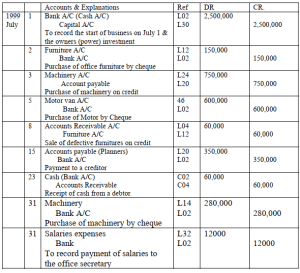
To enable the referencing, you require the chart of accounts.
| CHART OF ACCOUNTS Bank Account (cash) | 02 | ||||||
| Accounts Receivable | 04 | ||||||
| Furniture A/C | 12 | ||||||
| Machinery A/C | 14 | ||||||
| Motor Van A/C | 16 | ||||||
| Accounts payable | 20 | ||||||
| Capital | 30 | ||||||
| Salaries and wages | 32 | ||||||
| GENERAL LEDGER | |||||||
| TITLE: Bank/cash A/C | A/C No: 02 | ||||||
| DATE | EXPLANATION | RE F | DR | CR | BALANCE | ||
| 1999July | 1 | CapitalAccount | J1 | 2,500,000 | 2,500,000 | ||
| 2 | Furniture A/C | J1 | 150,000 | 2,350,000 | |||
| 5 | Motor van A/C | J1 | 600,000 | 1,750,000 | |||
| 15 | Accounts payable (planners) | J1 | 350,000 | 1,400,000 | |||
| 23 | Accounts Receivable | J1 | 60,000 | 1,460,000 | |||
| 31 | Machinery A/C | J1 | 280,000 | 1,180,000 | |||
| 31 | Salaries & Wages A/C | J1 | 12,000 | 1,168,000 | |||
TITLE:AccountsReceivable A/C NO:04
| DATE | EXPLANATION | RE F | DR | CR | BALANCE | |
| 199-July | 8 | Furniture A/C | J1 | 60,000 | 60,000 | |
| 23 | Bank A/C | JI | 60,000 | 0 | ||
TITLE:FurnitureA/C A/C NO:12
| DATE | EXPLANATION | RE F | DR | CR | BALANCE | |
| 199-July | 2 | Bank A/C | J1 | 150,000 | 150,000 | |
| 8 | A/C Receivable | J1 | 60,000 | 90,000 | ||
TITLE:MachineryA/C A/C NO:14
| DATE | EXPLANATION | RE F | DR | CR | BALANCE | |
| 199-July | 3 | Accounts payable | J1 | 750,000 | 750,000 | |
| 31 | Bank | J1 | 280,000 | 1030,000 | ||
TITLE: MotorVanA/C A/C NO:16
| DATE | EXPLANATION | RE F | DR | CR | BALANCE | |
| 199-July | 5 | Bank A/C | J1 | 600,000 | 600,000 | |
TITLE:Accountspayable A/C NO:20
| DATE | EXPLANATION | RE F | DR | CR | BALANCE | |
| 199-July | 3 | Machinery A/C | J1 | 750,000 | 750,000 | |
| 15 | Bank | J1 | 350,000 | 400,000 | ||
TITLE:Capital A/C A/C NO:30
| DATE | EXPLANATION | RE F | DR | CR | BALANCE | |
| 199-July | 1 | Bank | J1 | 2,500,000 | 2,500,000 | |
TITLE: salaries andwagesA/C A/C NO:32
| DATE | EXPLANATION | REF | DR | CR | BALANCE | |
| 199-July | 1 | Bank | J1 | 12,000 | 12,000 | |
To answer part (c) you need first to cover step 4 of the accounting cycle.
STEP4 The Trial Balance
Preparation Of A Trial Balance (Tb)
One aspect of a double-entry accounting system is that for every transaction there must be equal amounts of debit and credits recorded in the accounts. The equality of debits and credits posted to the ledger account is verified by preparing a list of all general ledger account in order in which they appear in the ledger with their current balances. The amount of accounts with debits balances are listed in one column and the amounts of accounts with credit balance are listed in the second column. The sum of the two columns should be equal. A Trial Balance may be prepared at any time to test the equality of the debits and credits in theledger.
The specimen below should be preliminary guide to the form and construction of a Trial Balance.
SPECIMEN OF TRIAL BALANCE
TRIAL BALANCE
AS AT 31ST MARCH 19…..
| Serial No. | Name of Account | Dr. | Cr. |
| Shs | shs | ||
| 1 | Capital A/c | 18,000 | |
| 2 | Purchase A/c | 2,500 | |
| 3 | Account payable | 8,000 | |
| 4 | Office Expenses A/c | 1,200 | |
| 5 | Insurance expenses A/c | 2,400 | |
| 6 | Rent A/c | 10,500 | |
| 7 | Salaries A/c | 10,000 | |
| 8 | Sale A/c | 55,000 | |
| 9 | Cash at Bank | 33,000 | |
| 10 | Cash in hand | 1,300 | |
| 11 | Debtors | 27,500 | |
| 12 | Creditors | 8,400 | |
| ——— | ——— | ||
| 89,400 | 89,400 | ||
| ======== | ===== |
From the above specimen, one will recognise that a Trial Balance is in a tabular form similar to the ruling of a Journal and, indeed, in practice a Journal is used for the representation of a Trial Balance. One should note that the Date Column is dispensed with as the statement is strictly prepared as a particular date; however the space is used for recording the Ledger page or serial number of the account from where balance is extracted and this is important for easy reference. The title of the account is written inthe
“Name of Account” column and the respective balances, i.e. Debit balances or Credit balances are written in the appropriate columns.
CONSTRUCITON OF A TRIAL BALANCE:
The construction of the trial Balance is bound to present some difficulty and you are advised to revise how accounts are balanced in the Ledger noting especially their normal balances. For this section, it is sufficient to note that in the Ledger there are three types of Accounts namely the Real, Nominal and Personal Accounts. These Accounts are balanced at the end of the accounting period either by bringing down the balances or transferring the balances to other accounts or in the case of personal accounts whose two sides are equal by merely ruling off. The important points to bear in mind are that Real Accounts extend to more than oneperiod;
Nominal Accounts are generally restricted to one period and include operational expenses or incidental gain. Personal Accounts can generally be of one period or extend to more than one period. Thus, the balances of Real Accounts are brought down as they are to appear in the next accounting period; the balances of Nominal Accounts are closed or transferred to income Summary account. Personal Accounts if they are fully paid or are equal on both sides are balanced and then the balance brought down.
A Trial Balance can be constructed in two ways (1) by means of totals (2) by means of balances.
The first method is seldom used these days as it is laborious and clumsy. The modern method of preparing the Trial Balance is to take out the balances of accounts ignoring altogether those accounts in which the amounts on the one side corresponds with amounts on the other side.
Constructing the Trial Balance by means of balances can be effected in two ways; either by asking one to extract the balance from the Ledger and tabulate them accordingly or tabulate the balances accordingly from a list of balances already extracted from the Ledger. Thus, in the latter case, the items have to be sorted into debits and credits, the totals of which must agree. The procedure is not so simple as it looks at first sight and one should familiarise oneself with the rules as discussed theprevious.
Refer to illustration 1 and prepare a trial balance. Extract the balances from the ledger accounts. Compare your solution with the one below
TRIAL BALANCE
AS AT 31ST MARCH 199…..
| Serial No. | Name of Account | Dr. | Cr. |
| Shs | Shs
400,0002,500,000 ————- 2,900,000======== |
||
| 1234 | Bank/Cash A/c Furniture MachineryMotor Van A/c | 1,168,00090,0001,030,000600,000 | |
| 5 | Account payable | ||
| 67 | Capital A/c Salaries andWages | 12,000————- | |
| 2,900,000 | |||
| ======== |
USES OF TRIAL BALANCE
Trial balance provides proof that the ledger is in Balance. If it balances it gives the assurance that
- Equal debits and credits have been recorded for alltransactions
- The debit and credit balance of each account has been correctlycomputed
- The addition of the account balances in the trial balances has been correctly performed.
If the debit and the credit totals of the TB do not agree, it means one or more errors has been made. Typical errors inculde:-
- the entering of credit as debit andviceversa
- Arithmetic mistake in balancingaccounts
- Clerical error in copying account balances into the trial balance egin stead of writing 87,000 one writes78,000
- Errors of principle listing the debit balances in the credit side of the Trial balance and viceversa.
- Errors of addition in the trial balance or subsidiarybooks.
- Omission of a balance of any account in the trialbalance.
LOCATING ERRORS
The lack of balance may be a result of combination of errors. There is no single technique, which will give the best results every time, but the following procedure done in sequence will often save considerable time and effort in locatingerrors.
- Prove the addition of the trial balance columns by adding these columns in the opposite direction from that previouslyfollowed.
- If the error doesn’t lie in addition, determine the actual error (difference) by which the schedule is out of thebalance.
=
- Rule of division by 9. If the difference is division by 9 it implies that it’s a transposition error or slide error e.g. cash account has a balance sh. 4,3385 but copied as sh. 4,835. The resulting error is 450/= all transposition errors are divisible by9.
- Slide error or incorrect placement of a decimal e.g. Shs. 408.75 copied as 40875/= the discrepancy will also be divisible by9
- Check for an entry with half the error or (discrepancy) – where a debit was entered as acredit.
- Check for the account with the exact discrepancy and determine the corresponding entry (either debit or credit) wasentered.
- Compare the amounts in the trial balance with the balances in the ledger check that the ledger balances are included in the correct column of the trialbalance.
- Recomputed the balance of each ledgeraccount.
- Trace all postings from the journal to the ledgeraccounts.
LIMITATION OF TRIAL BALANCE
A TB can still balance even when some Errors have been committed.
- If for example a purchase of furniture was erroneously recorded by debiting the land account instead of furniture A/C. The T.B would stillbalance.
- Also a complete omission of a transaction. The error would not be disclosed by the T.B.
However, trial balance acts as the stepping for financial statements e.g. balance sheet. ERRORS THAT A TRIAL BALANCE DOES NOT REVEAL
- Errors of Omission – a transaction is completely omitted from thebooks.
- Errors of Commission – this type of error is where the correct amount is entered but in the wrong personsaccount.
- Errors of Principle – where an item is entered in the wrong class of account e.g. if an asset such as motor van is debited to an expenses account such as motor expenses account.
- Compensating errors – where errors cancel out each other e.g. sales and purchases being overstated by the someamount.
- Error of original entry – where the original figure entered is incorrect, yet double entry is still observed using this incorrect figure. E.g. sales of 98,000/= entered as 89,000/= in both sales A/c and personalaccount.
- Complete Reversal of Entries – where the correct accounts are used but each item is shown on the wrong side of the account e.g. sales account debited and personal account credited instead of viceversa.
SUSPENSE ACCOUNTS
Accountants should try as much as possible to trace the errors and correct them. Where this effort is futile the trial Balance totals are made to agree or balance by inserting the amount of the difference between the credits and debits in a suspense account.
| Illustration Trial balance as at 31 Dec 2000 | ||
| Total after all the Accounts have been listed | Dr 154,740 | Cr 154,600 |
| Suspense account. | 140 | |
| 154,740 | 154,740 | |
| SUSPENCE ACCOUNT | ||
| DR | CR |
| 31/12/2000 DifferenceperT.B 140 |
Where the financial statement have to be prepared before the error is located the suspense Account Balance (if a credit balance) is added to the liabilities and Equity side of the balance sheet. If the balance is a debit it would be added to the assets in the balancesheets.
NB whenever the error is discovered it should be corrected by an appropriate journal entry.
EFFECT OF ERRORS ON REPORTEDPROFITS.
Errors discovered at a latterdateaffect the previous periodstatementswhen the error was committed butundetected.
Illustration
Assume that the trading & Loss A/c for the year 2000 was as follows
| $ $ | ||
| Sales | 100,000 | |
| Cost of sales | ||
| Opening stock | 5,000 | |
| Add Purchases | 61,000 | |
| Goods Available for sale | 66,000 | |
| Less: Closingstock | 7,500 | |
| Cost of goods sold | 58,500 | |
| Gross profit | 41,500 | |
| Add; Discount received | 2,800 | |
| 44,300 | ||
| Expenses | ||
| Salaries and wages | 14,000 | |
| Discount Allowed | 1,600 | |
| Rent expense | 2,500 |
| Telephone | 500 | |
| DepreciationTotal expense | 2,400 | 21,000 |
| Net Profit | 23,300 |
BALANCE SHEET
As at 31st Dec. 2000
| Fixed Costs:Fixtures | 45,000 | |
| Less AccumulatedDepreciation | 12,000 | |
| Net fixed asset | 33,000 | |
| Current Assets Cash in hand | 1,500 | |
| Cash at bank | 60,000 | |
| Stock | 7,500 | |
| Debtors | 4,500 | |
| Total current assets | 73,500 | |
| Current LiabilitiesRent payable 200Creditors 3,500 | 3,700 | |
| Net current Assets | 69,800 | |
| Suspense | 5,000 | |
| Net assets | 74,800 | |
| Financed by: Capital:Balance as 1/1/2000 | 60,000 | |
| Add Net profit | 23,300 | |
| Less; Drawing | 8,500 | |
| 74,800 |
The following errors were discovered in 2002 but relate to the year 2001.
- Sales under cast by$500
- Salaries and wages over stated by $1,500
- Cash payment to a creditor entered in the cash book only $3,000.
- Complete commission of drawing by cheque $450.
- A purchase of $ 7,650 was entered in the book as $ 6,750 both credit anddebit.
- Discount received over cast$1,000
REQUIRED
(I) For each of the above errors show the effectin the net profit and prepare the corrected profit and loss account.
| (2) Show the suspense account after errors are corrected. | ||||
| solution | ||||
| Statement of corrected Net profit for the year ended 31 Dec.2000 | ||||
| Net profits for the accountsUnder costofsales (1) 500Add: over cast of salaries andwages(2) 1,500 | 23,300
2,000 |
|||
| 25,300 | ||||
| Less Discountreceivedovercast 1,000 Purchaseunderstated 900 | 1,900 | |||
| Corrected Net Profit | 24,400 | |||
| NB Errors not affecting the net profit:(3) Creditors were overstated in the balancesheet.(4) Bank balance in the balance sheet is overstated and the drawing understated.
The corrected suspense A/c appears below suspense A/c |
account is | |||
| 31/12/2000 difference in T.B | 5,000 | 31/12/2000 Salaries &wages | 1,500 | |
| 31/12/200Sales | 500 | 31/12/2000 Discount Received | 1,000 | |
| 31/12/2000 Creditors | 3,000 | |||
| 5,500 | 5,500 | |||
NB Errors No. 4 and 5 are not corrected using a suspense account as they do not make the Trial Balance to be out of balance
ILLUSTRATION III
This illustration helps to understand the practice the accounting cycle procedures. Try it before checking the solution
The following transactions were recorded in the book of ABC company limited in the first month ofoperation.
JUNE
1 Mr. A deposited Shs. 600,000 cash in the Bank for the real estatebusiness.
1 An agreement for the firm to manage on apartment complex for a monthly fee of Shs. 400 to be paid on the fifth day of the followingmonth.
1 Purchase land and office building for Shs.72,000 the terms of the agreement providedforacashpaymentofShs.120,000theremaindertobefinancedwitha
20 year mortgage bearing interest at 12% per year. The purchase price is allocated Shs. 100,000 to land and Shs. 620,000 tobuilding.
3 Cash payment of Shs. 96,000 was made for a 24 month fire and business liability insurance policy.
5 .Purchased office supplies for the amount of 6,200 oncredit.
5 Purchase office furniture and equipment for a total price of 96,000 paid 50,000 in cash with the balance due in60-days.
- Hired two sales agents and an officesecretary
- Paid Sh 1,200 for radio commercial aired on June 3rd and 4th.
15 Sold a residence that had been listed with the firm. A commission of Shs. 42,000 was earned on the sale to be received when loanscloses.
- Paid salaries and wages for the two weeks, 18,000/=cash.
- He performed an appraisal and was paid Ksh. 2,500cash
23 The owner withdrawal Ksh 6,000 cash for personaluse
27 Paid for the office supplies purchase oncredit.
- Received Ksh.2,800 for an appraisal to be performed inJuly.
- Paid telephone bill Kshs 7,200cash
30 The loan closed the commission wasreceived.
| CHART OF ACCOUNTS | |||||||
| Cash/bank | 001 | Office supplies exp. | 076 | ||||
| Account Receivable | 005 | Depreciation Exp. | 078 | ||||
| Land | 010 | Acc Dep. Bidg | 056 | ||||
| Building | 012 | Furniture | 058 | ||||
| Note Payable | 032 | Insurance Exp. | 080 | ||||
| Prepaid insurance | 008 | Interest Exp. | 082 | ||||
| Office Supplies | 006 | interest payable | 036 | ||||
| Accounts payable | 030 | Unearned appraisal fees | 054 | ||||
| Office equipment | 014 | Advertising Exp. | 070 | ||||
| Commission Revenue | 060 | Salaries & wages | 072 | ||||
| Appraisal fees | 062 | Drawing A/c | 052 | ||||
| Telephone Exp. | 074 | Capital A/c | 050 | ||||
| REQUIREDa) | |||||||
| = | |||||||
- Journalize the JuneTransactions
- Post to a running balance ledgeraccounts
- Prepare a trialbalance.
(b) Assume monthly financial statements were to beprepared.
- prepare adjusting journalentries
- post theadjustment
- prepare adjusted trialbalance
- prepare a balance sheet as at 31st June and an income
SOLUTION : ILLUSTRATIONIII
Journal Entries:
| DATE | ACCOUNT & EXPLAINATIO | REF | DR | CR |
| JUNE1 | Cash A/cCapital A/cTo record cash invested by the owner | L/001 L/050 | 60,000 | 60,000 |
| 1 | Land A/c | L/010 | 100,000 | |
| Building A/c | L/012 | 620,000 | ||
| Cash A/c | L/001 | 120,000 | ||
| Notes payable A/c | L/032 | 600,000 | ||
| Purchase of land and building party in cash | ||||
| and party by a 20-year mortgage beginning | ||||
| 12% interest. | ||||
| 3 | Prepaid insurance A/c CashPayment of a 24-month insurance fire and business liability insurance policy. | L/008 L/001 | 9,600 | 9,600 |
| 5 | Office supplies A/c Accounts paymentsTo record purchase of office supplies on credit | L/026 L/030 | 6,200 | 6,200 |
| 5 | Office equipment CashAccounts payablePurchase of furniture and equipment partly in cash and balance to be paid in 60 –days. | L/014 | 96,000 | |
| L/001 | 50,000 | |||
| L/030 | 46,000 | |||
| 6 | Advertising Exp. A/c Cash A/cPayment for radio commercial aired on 3rd and 4th of June | L/070 L/001 | 1,200 | 1,200 |
| 15 | Accounts receivable A/c Commission RevenueTo read commission earned to be received when the loan is closed. | L/005 L/060 | 42,000 | 42,000 |
| 22 | Salaries and wages A/c CashPayment of two weeks salaries and wages. | L/072 L/001 | 18,000 | 18,000 |
| 23 | CashAppraisal fee revenue A/c To record appraisal fee received. | L/001 L/062 | 2,500 | 2,500 |
| 23 | Drawing A/cCashMoney withdrawn for personal use by the owner. | L/052 L/001 | 6,000 | 6,000 |
| 27 | Accounts payableCashPaid for the office supplies purchased on credit. | L/030 L/001 | 6,200 | 6,200 |
| 29 | CashUn earned appraisal feesTo record money received for an appraisal to be performed inJuly. | L/001 L/054 | 2,800 | 2,800 |
| 30 | Telephone expensesCashPayment of telephone bill. | L/074 L/001 | 7,200 | 7,200 |
| 30 | CashA/c ReceivableReceipt of commission earned on June 15 | L/001 L/005 | 42,000 | 42,000 |
NOTE:
- The transaction of June 1 of signing an agreement does not create a recordable asset or revenue and therefore is not given accountingrecognition.
- The transaction of June 5 of hiring of employee is not given accounting recognition since there are no effects at this time on the firm’s accountingequation.
TITLE:CASH A/CNo.001
| June | Date | Explanation | Ref | Dr | Cr. | Balance |
| 1 | Capital A/c | J1 | 600,000 | 600,000 | ||
| 1 | Land & building | J1 | 120,000 | 480,000 | ||
| 3 | Pre paid insurance | J1 | 9,600 | 470,000 | ||
| 5 | Office equipment | J1 | 50,000 | 420,000 | ||
| 6 | Advertising Exp. | 1,200 | 419,200 | |||
| 22 | Salaries and wages | 18,000 | 401,200 | |||
| 23 | Appraisal fee revenue | 2,500 | 403,700 | |||
| 27 | Drawing A/c | 6,000 | 39,1500 | |||
| 29 | Unearned appraisalfees | 2,800 | 391,500 | |||
| 30 | Telephone Exp | 7,200 | 387,100 | |||
| 30 | A/c receivable | 42,000 | 429,100 | |||
TITLE:LAND A/c No.010
| June | Date | Explanation | Ref | Dr | Cr. | Balance |
| 1 | Cash /note payable | 100,000 | 100,000 | |||
TITLE:ACCOUNTSRECIEVABLE A/c No.005
| June | Date | Explanation | Ref | Dr | Cr. | Balance |
| 15 | Commission Rev. | J1 | 42,000 | 42,000 | ||
| 30 | Cash | 42,000 |
TITLE:ACCOUNTSPAYABLE A/c No.030
| June | Date | Explanation | Ref | Dr | Cr. | Balance |
| 5 | Off. Supplies A/c | 6,200 | 6,200 | |||
| 5 | Off Equipment | 46,000 | 52,200 | |||
| 27 | Cash | 44 | 6,200 | 46,000 |
TITLE: NOTESPAYABLEA/c A/c No.032
| June | Date | Explanation | Ref | Dr | Cr. | Balance |
| 1 | Land & building | 44 | 600,000 | 600,000 | ||
TITLE:CAPITALA/C A/c No. 050
| June | Date | Explanation | Ref | Dr | Cr. | Balance |
| 1 | Cash A/c | 44 | 600,000 | 600,000 | ||
TITLE: BUILDING A/cNo.012
| June | Date | Explanation | Ref | Dr | Cr. | Balance |
| 1 | Cash/Note payable | 43 | 620,000 | 620,000 | ||
TITLE:PREPAIDINSURANCE A/c No008
| June | Date | Explanation | Ref | Dr | Cr. | Balance |
| 3 | Cash | 9,600 | 9,600 | |||
TITLE:OFFICESUPPLIESA/C A/c No.006
| June | Date | Explanation | Ref | Dr | Cr. | Balance |
| 5 | A/c payable | 43 | 6,200 | 6,200 | ||
TITLE:OFFICEEQUIPMENT A/c No.014
| June | Date | Explanation | Ref | Dr | Cr. | Balance |
| 5 | Cash A/c payable | 43 | 96,000 | 96,000 | ||
ADVERTISINGEXPENSE A/c No.070
| June | Date | Explanation | Ref | Dr | Cr. | Balance |
| 6 | CashA/c | 44 | 1,200 | 1,200 | ||
COMMISSIONREVENUE A/c No060
| June | Date | Explanation | Ref | Dr | Cr. | Balance |
| 15 | A/C Receivable | 44 | 42,000 | 42,000 | ||
SALESAND WAGES A/c No.072
| June | Date | Explanation | Ref | Dr | Cr. | Balance |
| 22 | Cash | 44 | 18,000 | 18,000 | ||
APPRAISALFEES A/c No. 062
| June | Date | Explanation | Ref | Dr | Cr. | Balance |
| 23 | Cash | 44 | 2,500 | 2,500 | ||
DRAWINGSA/C A/c No.052
| June | Date | Explanation | Ref | Dr | Cr. | Balance |
| 23 | Cash | 44 | 6,000 | 6,000 | ||
UNEARNEDREVENUE A/cNo.054
| June | Date | Explanation | Ref | Dr | Cr. | Balance |
| 29 | Cash | 44 | 2,800 | 2,800 | ||
TELEPHONEEXPENSE A/cNo.074
| June | Date | Explanation | Ref | Dr | Cr. | Balance |
| 30 | Cash | 44 | 7,200 | 7,200 | ||
A COMPANY LIMITED TRIAL BALANCE
AS AT JUNE 30TH 19 —
| ACCOUNTNAME | DR | CR | ||
| Kshs. | Kshs. | |||
| Cash | 429,100 | |||
| Land | 100,000 | |||
| Accounts Payable | 46,000 | |||
| Notes Payable | 600,000 | |||
| Capital A/C | 600,000 | |||
| BuildingPre Paid Insurance | 620,000 | |||
| Office Supplies A/C | 9,600 | |||
| Office Equipment | 6,200 | |||
| Advertising Expenses | 96,000 | |||
| Commission Revenue | 1,200 | |||
| Salaries And Wages | 42,000 | |||
| Appraisal Fees | 18,000 | |||
| Drawing Account | 6,000 | 2,500 | ||
| Unearned Revenue | ||||
| Telephone | 7,200 | 2,800 | ||
| 1,293,300 | 1,293,300 | |||
STEP 5 Adjusting Accounts And Preparing Financial Statements
Many transactions recorded during a period affect the current periods financial statements as well as those prepared in future periods for example; The cost of a 24 month insurance policy purchased in the current period should be allocated as an expense to all accounting periods receiving the protection.
There are also other events such as the increase in interest revenue earned on notes receivable which are often recorded at the end of the current period. This as part of the accounting cycle, the accounts an source documents are analysed and entries made to adjust the accounts before the financial statements are prepared. These entries are called adjusting entries.
The adjusting entries are recorded to the general journal and posted to the ledger. A trial balance called an adjusted trial balance is then drawn from the general ledger to varify the equality of debits and credits the financial statements are then prepared from the adjusted trial balance. Therefore the other remaining steps in the accounting cycle are:
- recording adjustingentries.
- Preparation of an adjusted trialbalance
- Preparation of financialstatements.
- Recording closing entries CLASSIFICATION OF ADJUSTINGENTRIES
Adjusting entries are classified into four general categories.
- Entries to apportion recorded costs : A cost that will benefit more than one accounting period. Initially recorded by debiting on asset account. Adjustments are made to allocate a portion of the assets cost to expense e.g.building.
- Entries to apportion unearned revenue : where advance collection is done for services to be rendered in future accounting periods. In the period in which the services are rendered an adjusting entry is made to record the portion of the revenue earned during theperiod.
- Entries to record unrecorded expenses :- Incurrence of an expense in current accounting period yet no bill received hence payment will be done in a future period.
- Entries to record unrecorded revenue:- Revenue earned but not yet billed to customers or recorded in accountingrecords.
In determining whether an adjusting entry is needed the accountant examines the appropriate source document e.g. insurance policy or the billing from the insurance company. The account balances listed in the trial balance are examined to compute the amount of the adjustmentneeded.
ILLUSTRATION III Continued.
Consider the A limited trial balance. Such a trial balance is called unadjusted trial balance because it is prepared from the general ledger before the adjusting entries are recorded.
Assume that monthly financial statements are to be prepared and therefore monthly adjusting entries are required.
- PrepaidExpenses
Prepaid insurance to entered June 3 covers a period of 24 months. Monthly insurance expenses = 9600/24 = 400
PrepaidInsurance Insuranceexp BalB/f 9,600 30/6 insuranceExp.400 30/6 Prepaid400
- Office Supplies Inventory (entered June5)
The cost of unused office supplies is report as an asset in the balance sheet. As the office supplies are used their cost is transferred to an expense account. The recognition of the expenses is normally deferred until the end of the accounting period, (in a manual Accounting Systems).
Assume that the cost of supplies that A ltd had on hand at the end of June was Shs 5,400. The cost of supplies used would be Shs. 800 i.e.(6,200-5,400)
30/6 officesuppliesExpense 800
officesupplies A/C 800
To record supplies used for the month
SuppliesExpense Suppliesa/c
30/6 800 30/6 bal. 6,200 30/6 800
Journal Entry
June30 InsuranceExpenses 400
PrepaidInsurance 400
Being adjusting entry For insurance expense
When this entry is posted to the appropriate ledger account, the accounts will be as shown below.
- Depreciation Of Equipment AndBuilding
To provide proper matching of revenue with expenses the cost of each asset less its estimated residual value is allocated as an expense in the accounting period in which the asset is expected to be used to produce revenue.
The residual value of plant asset is its estimated value at the end of its useful life. The amount of time that the asset is expected to be used is called its estimated useful life. The position of the assets cost assigned to expense is referred to as depreciation. In making the adjusting entries for depreciation a separate account call accumulated depreciation is credited for the cost associated with the period. This is done instead of making a direct credit to the assetaccount.
The balance in the accumulated depreciation is the portion of the cost that has been assigned to expense since the time the assetpurchased.
The accumulated depreciation account is an example of a central account.
A contra account is reported as an off set to or deduction from a related account.
In our illustration let assume that the building has a useful life of 25 years at which time is expected to have a residual value of Kshs 20,000 and the office equipment has a eight- year estimated useful life and a zero redual value at the end of eight years. There are various methods that can be used to calculate depreciation. At this point we shall use straight line method and the other methods will be covered in the next lesson. Straight line methods allocate equal depreciation expensed period. The monthly depreciation assuming straight linemethod:-
The monthly depreciation assuming straight line method:- Depreciationperperiod = Cost – Residualvalue
Useful life
Hence:
DepreciationforBuildings = (620,000 – 20,000)/ (25 x 12) month. = 2,000 Depreciation Officeequipment= (96,000 – 0)/ 8×12 = 1,000
Journal entry:
30/6 Depreciationexpense 3,000
Accumulateddep. Building 2,000
Accumulateddepreciation equipment 1,000 To record depreciation for the month ofJune
The depreciation expense is reported as an expense in the income statement. The building and office equipment account will be shown in the balance sheet as follows.
| FIXED ASSET | ||
| Building | 620,000 | |
| Less Acc. Depreciation: Building | 2,000 | Shs.618,000 |
| Office equipment | 96,000 | |
| Less Acc. Depreciation: Equipment | 1,000 | Shs. 95,000 |
| Interest Expense |
The mortgage has an interest rate of 12% hence monthly interest expense is computed as follows:-
Interestexpense = 12% x600,000
12 months
= 6,000
Journal Entries
30/6 Interestexpense 6000
Interestpayable 6000
To record the interest expense for the month of June
Interest Exp. Interest payable
30/6 6,000 30/66,000
The difference between the original cost of the asset and its accumulated depreciation is called the Book Value of the asset and represents the unexpired cost of the asset.
Unearned Revenue
A firm may receive payment in advance for services that are to be performed in the future until the service is performed a liability equal to the amount of the advance payment is reported in the balance sheet. Thus the firms obligation to perform future services is reported.
Unearned Appraisal Fees
Assuming that the services were performed in July then the following entry will be entered.
July16 Unearnedappraisalfees 2,500
AppraisalfeesRevenue 2,500
Between the totals of the two income statements columns and enter this as a balancing amount in both the income statement and balance sheet columns. Add the four columns together with the balancing amount include.
ADJUSTED TRIAL BALANCE
After adjusting entries, have been journalised and posted to the ledger accounts on adjusted trial balance is prepared to test the equality of debits with the credits.
A LTD
Adjusted Trial Balance As at 30/6/92
| ACCOUNT NAME | DEBITS(Shs.) | CREDITS(Shs) |
| Cash | 429,100 | |
| Land | 100,000 | |
| Accounts payable | 46,000 | |
| Notes payable | 600,000 | |
| Capital | 600,000 | |
| Building | 620,000 | |
| Prepaid insurance | 9,200 | |
| Office supplies A/c | 5,400 | |
| Office equipment | 96,000 | |
| Advertising expense | 1,2000 | |
| Commission Revenue | 42,000 | |
| Salaries and wages | 18,000 | |
| Appraisal fees | 2,500 | |
| Drawing A/c | 6,000 | |
| Unearned appraisal Revenue | 2,800 | |
| Telephone expenses | 7,200 | |
| Interest expenses | 6,000 | |
| Insurance Expenses | 400 | |
| Interest payable | 6,000 | |
| Office supplies | 800 | |
| Depreciation Exp. | 3,000 | |
| Accumulateddepciation:.building | 2,000 | |
| Accumulated depciation: Office equipment | 1,000 | |
| ————- | ————- | |
| TOTAL | 1,302,300 | 1,302,300 |
PREPARATION OF FINANCIALSTATEMENT
After the adjusting process is complete the financial statements can be prepared directly from the adjusted trial balance.
Income Statement
The major purpose/objective of the income statements is to get the net income of the period. For this purpose all the revenues will be added together and all expenses will be subtracted from the revenues to determine the net income.
Therefore: Net Income = Revenue –Expenses. Illustration IIIcontinued:
Using the Adjusted Trial Balance we can prepare an income statement and a Balance Sheet as shown below.
A Ltd INCOME STATEMENT
For The Period Ended June 30 1992
| Revenues | ||
| Commission Revenue | 42,000 | |
| Appraisal fee | 2,500 | |
| Total revenue | 44,500 | |
| Expenses | ||
| Salaries and wages Exp. | 18,000 | |
| Insurance Exp. | 400 | |
| Office Supplies Exp. | 800 | |
| Depreciation Exp. Building | 2,000 | |
| Depreciation Exp. Office Equip. | 1,000 | |
| Advertising Exp. | 1,200 | |
| TelephoneExp. | 7,200 | |
| Interest Exp. | 6,000 | 36,600 |
| Net Income | 7,900 | |
BALANCE SHEET
A balance sheet reports the financial position of a firm on a specific date as opposed to income statement which reports the flow of revenue and expenses during a period.
A Ltd BALANCE SHEET
AS AT30/6/92
| Fixed Assets | Shs. | Shs. |
| Land | 100,000 | |
| Building | 620,000 | |
| Less Acc. Depreciation-building | 2,000 | 618,000 |
| Office Equipment | 96,000 | |
| Less Acc. Dep. Office equipment | 1,000 | 95,000 |
| 813,000 | ||
| Current Assets | ||
| Office supplies | 5,400 | |
| A/c Receivable | – | |
| Prepaid insurance | 9,200 | |
| Cash A/c | 429,100 | |
| 443,700 | ||
| Current liabilities | ||
| Interest payable | 6,000 | |
| A/c Payable | 4,600 | |
| Unearned appraisal fees | 2,800 | 388,900 |
| Net Assets | 1,201,900 | |
| Financed by: | ||
| Long term liabilities | ||
| Note payable | 600,000 | |
| Capital | 600,000 |
Addnet Income 17,900
Lessdrawings 6,000 601,900
1,201,900
THE CLOSING ENTRIES
The income statement reports revenue earned and expenses incurred to earn those revenues during a single accounting period. Data needed to prepare the income statement are accumulated in the individual revenue and expense accounts. Once theincome
statement has been prepared for the current period the revenue and expense account have served their purpose and they are closed or cleared by transferring their balances to the income summary account. The closing process results in each expense revenue account beginning the next period with a zero balance.
Because revenue and expense accounts are closed each period they are called Temporary or Nominal accounts.
Balance sheet accounts are not closed the ending balance of one period are carried forward and becomes the beginning balance of next period. Thus balance sheet accounts are called permanent or real accounts.
STEPS IN CLOSING THE BOOKS:
Closing entries are generally made in the following sequence:
- Each revenue account is reduced to zero by transferring its balance to the income summaryaccount.
- Each expense account is reduced to zero by transferring the balance to the income summary account
- The balance in the income summary account is transferred to the owner’s capital account.
- The balance in the owner’s drawing balance in the owner’s drawing account is transferred to the owner’s capital account.
Illustration
Assume that x Ltd had the following balances in the revenue and expense accounts after the preparation of year end financial statements.
| Salaries and wages | 270,900 | |
| Commission expenses | 480,000 | |
| Utilities expenses | 28,200 | |
| Advertising expenses | 12,000 | |
| Office supplies expense | 8,000 | |
| Insurance expense | 4,000 | |
| Depreciation Exp. Building | 20,000 | |
| Depreciation Exp. Office Equipment | 10,000 | |
| Interest Expense | 6,000 | |
| Commission Revenue | 960,000 | |
| Appraisal fees Revenue | 25,000 | |
| Service fees Revenue | 40,000 | |
| Drawings | 6,000 | |
| REQUIRED | ||
| 1. Close these account to the income summary |
- Close Income summary and drawing A/c to capital account.
Solution
| (i) | CommissionRevenue | 960,000 | |
| Appraisal Revenue | 25,000 | ||
| Service fees RevenueIncome summary | 40,000 | 1,025,000 |
To close Revenue A/c
| (ii) | Income Summary | 839,100 | |
| Salaries and wages | 270,900 | ||
| Commission expenses | 480,000 | ||
| Utilities Expense | 28,200 | ||
| Advertising exp. | 12,000 | ||
| Office Supplies Exp. | 8,000 | ||
| Insurance Exp. | 4,000 | ||
| Depreciation Exp: Building | 20,000 | ||
| Depreciation Exp: Office Equip. | 10,000 | ||
| Interest exp. | 6,000 |
To close the Expense A/c
- IncomeInsummary 185,900
Ownerscapital 185,900
To close the Incomesummary
- Ownerscapital 6,000
DrawingsA/c 6,000
To close the drawing A/c
IncomeSummaryA/c Totalexp. 839,100 Total Revenue1,025,000
OwnersCapital 185,900
1,025,000 1,025,000
Step 9: THE POST- CLOSING TRIAL BALANCE
After the closing entries have been posted, a trial balance may be prepared to varify the equality of debit and credits in the ledger. The trial balance is known as a post closing trial balance.
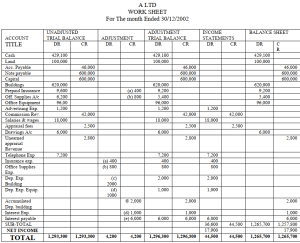
PREPERATION OF A WORK SHEET
A work sheet is a device designed to bring together in one place the information needed to prepare formal financial statements and to record the adjusting and closing entries. It should be noted that worksheetare:
- not part of the permanent accountingrecords
- not prepared for use by the owners or management of thefirm
- replaces neither the financial statements nor the necessity to Journalize and post the adjusting and closing entriesand
- are tools used to gather and organize the information needed to complete the accounting cycle.
STEPS IN PREPARATION OF A WORK SHEET.
- Enter the ledger account titles and balances in the account title and un adjusted trial balance columns,respectively.
- Enter the necessary adjusting entries in the adjustments columns – key letters can be placed forreference.
- Prepare an adjusted trial balance by considering the entry in the unadjusted Trial Balance, making the necessary Adjustment and determining the adjusted balance.
- Extend every account balance listed in the adjusted trial balance column to its proper financial statement column. I.e either income statement or balancesheet.
- Add the two income statement and the two balance sheet columns. Compute thedifference.
ILLUSTRATION III Continued:
Recall the following adjusting journal entries for A Ltd
| a) Insurance ExpensePrepaid Insurance | 400 | 400 |
| b) Office supplies expensesOffice supplies A/c | 800 | 800 |
| c) Depreciation ExpenseAccumulated Depreciation: Building | 3,000 | 2,000 |
| Accumulated Depreciation: Equipment | 1,000 | |
| d) Interest expenseInterest payable | 6,000 | 6,000 |
Self Testing Problem
To illustrate recording in a general journal, assume that the transactions listed below for the garden shop took place in May 2001, during its first month of operations:
May 1 Certificate of incorporation was received authorizing the issuance of 100,000 Shares of $ 5 per common stock. Issued 16250 shares at $ 8 per share.
May 1 Borrowed $ 30,000 from Caty Bank by issuing a $ 30,000 note due in two years.
Interest at 10% is payable annually.
May 1 Purchased the assets of real-value landscapers for $ 75000 in cash. The assets Consisted of inventory of $ 60,000, supplies of $ 4000, and fixtures and Equipment of $ 11000.
May 2 Paid rent on a building for 12 months in advances $ 7200. Debited rent expense.
May 3 Purchased display equipment for $ 10,000 from East African Company.Paid $ 2000 cash, the balance in 60 days.
May 4 Purchased merchandise on account from quick wholesale. The cost of the merchandise was $ 44100.
May 4 Paid $ 1800 cash for supplies, which were recorded as an asset.
May 5 Sold miscellaneous items totalling $ 25000 to Ace Nursery on account
May 9 Purchased merchandise costing $ 30,000 from plants Inc, on account. The transportation cost on the merchandise totaled $ 250 and was paid in cash.
May 11Received $ 12000 of the amount due from Ace Nursery May 12 Paid salaries totaling $ 3000
May 20 Cash sales of lawn supplies, $ 15000
May 20 Subleased the top floor of the building rented on May 2 for $ 300 per month. Credited rent revenue.
May 22 Received $ 5000 from sale of gift certificates. Credited unearned revenue-gift certificates
May 24 Purchased temporary investments for cash at a cost of $ 3600 May 25 Returned defective merchandize costing $ 1200 to plants, Inc
May 26 Sold miscellaneous lawn supplies totaling $ 24000 to rite-way construction. Rite-way paid $ 6000 cash, and the balance was on account.
May 28 Paid the amount due to Quick wholesale, $ 441000
May 29 Purchased merchandise on account from Handy & Dandy supply at a cost of $ 6000 May 30 Cash sales of lawn supplies, $ 18000
The above transactions are recorded in general journal form. Notice the format of the General journal and of the journal entries. The first column in the journal shows the date of the transaction. Next, the accounts debited and credited and a brief explanation of the
transaction are shown Go through the steps once to remondyour self of the journalizing procedure. Finally, the last two columns are for the dollar amounts of the
debits and credits.
General Journal Entries
The Garden Shop General Journal
PAGE: 1
| Date | Account Title and explanation | Ref | Debit | Credit |
| May 1 | CashCommon Stock Share premiumTo record sale of common stock | 130,000 | 8125048750 | |
| May 1 | CashNotes payableTo record issuance of notes payable | 30,000 | 30,000 |
| May 1 | Inventory Suppliesfixtures and Equipment CashTo record acquisition of assets of rent Value landscapers | 60,0004,00011,000 | 75,000 | |
| May 2 | Rent expenseCashTo record advance payment of rent | 7200 | 7200 | |
| May 3 | Fixtures and equipment CashAccounts payableTo record purchase of equipment | 10,000 | 20008000 | |
| May 4 | SuppliesCashTo record purchase of supplies | 1800 | 1800 | |
| May 5 | Accounts receivable SalesTo record sales on credit | 25000 | 25000 | |
| May 9 | Purchases Transport expensesAccounts payable CashTo record purchases of merchandise and related freight costs | 30000250 | 30000250 | |
| May 11 | CashAccounts receivableTo record collections from customers | 12000 | 12000 | |
| May 12 | Salaries expense CashTo record salaries expense | 3000 | 3000 | |
| May 20 | CashSalesTo record cash sales of merchandise | 15000 | 15000 | |
| May 20 | CashRent revenue | 300 | 300 |
| To record receipt of rent in advance | ||||
| May 22 | CashUnearnedrevenue- gift certificates To record receipt of cash for giftcertificate | 5000 | 5000 | |
| May 24 | Investments CashTo record purchase of investments | 3600 | 3600 | |
| May 25 | Accounts payable Purchase returnsTo record return of detective merchandise | 1200 | 1200 | |
| May 26 | CashAccounts receivable SalesTo record cash sales & sales on credit | 600018000 | 24000 | |
| May 28 | Accounts payable CashTo record payment of amount due | 44100 | 44100 | |
| May 29 | PurchasesAccounts payableTo record purchases on credit | 6000 | 6000 | |
| May 30 | CashSalesTo record cash sales | 18000 | 18000 |
Key words:
- Account
- Journal
- General
- TrialBalance
- SourceDocuments
- Books of original entry
- Debits and Creditrules
- Normal AccountsBalance
- Posting
- Adjusting
- Worksheet
PROBLEMS
Problem 2.1
Tradar Winds Airlines provides passenger and freight service among some Pacific Islands. The accounts are adjusted and closed each month. At June 30 the trial balance shown below was prepared from the ledger.
TRADAR WINDS AIRLINES
Trial Balance June 30, 2000
| £ | £ | |
| Cash | 38,000 | |
| Prepaid rent | 9,600 | |
| Unexpired insurance | 21,000 | |
| Prepaid maintenance service | 22,500 | |
| Spare parts | 57,000 | |
| Airplanes | 664,000 | |
| Accumulated depreciation: airplanes | 108,000 | |
| Notes payable | 400,000 | |
| Unearned passenger revenue | 60,000 | |
| Stephen Morry, Capital | 231,050 | |
| Stephen Morry , drawing | 12,000 | |
| Passenger revenue earned | 110,950 | |
| Fuel expense | 13,800 | |
| Salaries expense | 66,700 | |
| Advertising expense | 5,400 | |
| Additional information | £910,000 | £910,000 |
- Monthly rent amounted to £ 3,200 reducing the Prepaid Rent account to £6,400.
- Insurance expense for June was £ 2,400. Reduce the Unexpired Insuranceaccount.
© All necessary maintenance work was provided by Ryan Air Service at a fixed charge of £ 7,500 a month. Service for three months had been paid for in advance on June 1. (Debit MaintenanceExpense).
- Spare parts used in connection with maintenance work amounted to £ 3,750 during the month. (Debit Maintenance Expense. Use two lines on work sheet for this expense account).
- Depreciation of the airplanes for the month of June was £7,200.
- The Chamber of Commerce had purchased 2,000 special tickets for £ 60,000. Notethat the special price per ticket was £30. Each ticket allowed the holder one flight. During the month 400 of these special price tickets had been used by the holders. (Debit Unearned Passenger Revenue).
- Salaries earned by employees but not paid amounted to £ 3,300 at June30.
- Interest accrued on notes payable at June 30 amounted to £7,000.
Required:
- Prepare a work sheet for the month ended June 30,2000
- Prepare an income statement, a statement of owner’s equity, and a balancesheet.
© Prepare adjusting and closing journalentries.
Problem 2.2
MsRobinson , after completing her medical education established her own practice on May 1. The following transactions occurred during the first month.
May 1 Ms Robinson opened a bank account in the name of the practice, Robs Health Care (RHC) by making a deposit of £ 42,000.
May 1 Paid office rent for May, £ 1,000
May 2 Purchased office equipment for cash, £ 6,200
May 3 Purchased medical instruments from Niles Instruments, Inc. at cost of £ 19,000. A cash down payment of £ 9,000 was made and a note payable was issued for the remaining £ 10,000.
May 4 Agreement signed with Granny Hospital to be on call for emergency service at a monthly fee of £ 1,400. The fee for May was collected in cash.
May 15 Excluding the receipt for May 4, fees earned during the first 15 days of the month amounted to £ 3,600 , of which £ 2,400 was in cash and £ 1,200 was in accounts receivable.
May 15 Paid Mary, the secretary her salary for the first half of May, £ 00. May 16 Dr. Robinson withdrew £ 975 for personal use
May 19 Treated Joyce Truda for minor injuries received in an accident during employment at Granny Hospital . No charge was made as these services were covered by the payment on May 4.
May 27 Treated Joshua, who paid £ 50 cash for an office visit and who agreed to pay £ 75 on June 1 for laboratory medical tests completed May 27.
May 31 Paid the secretary £ 800 salary for the second half of month.
May 31 Received a bill from MarkGray Medical Supplies in the amount of £ 840 representing the amount of medical supplies used during May.
May 31 Paid utilities for the month, £ 300
Other information
Dr. Robinson estimated the useful life of medical instruments at 6 years and of office equipment at 10 years. The follows is the Chart of Accounts used by Robs Health Care (RHC):
Cash 10 Robison,drawing 41
Accounts receivable 13 Incomesummary 43
| Medical instruments | 20 | Fees earned | 45 |
| Accumulated depreciation: | Medical supplies expense | 50 | |
| Medical instruments | 21 | Rent expense | 51 |
| Office equipment | 22 | Salaries expense | 52 |
| Accumulated depreciation: | Utilities expense | 53 | |
| Office equipment | 23 | Depreciation expense: | |
| Notes payable | 30 | Medical instruments | 54 |
| Accounts payable | 31 | Depreciation expense: | |
| Robison, capital Required: | 40 | Office equipment | 55 |
- Journalize the above transactions. (Number journal pages to permit cross-reference to ledger).
- Post to ledger accounts. (Use running balance form of ledger account. Numberledger accounts to permit cross reference tojournal).
- Prepare a trial balance at May 31,2000
- Prepare adjusting entries to record depreciation for the month of May and post to ledger accounts. (For medical instruments, cost £ 9,000 ¸ 6 years x 1/12. For office equipment, cost £ 7,200 ¸ 10 x1/12).
- Prepare an adjusted TrialBalance.
- Prepare an income statement and a balance sheet in reportform.
- Prepare closing entries and post to ledgeraccounts.
- Prepare an after-closing trialbalance.
Problem 2.3
The following is an unadjusted trial Balance for Saidia Enterprises as at 31st. January for the first month ofoperation.
DR CR
Cash 215,000
Prepaid Insurance 12,000
ShorttermInvestment 6,000
AccountsReceivable 20,000
Furniture&Fittings 50,000
Equipment 75,000
OfficeExpenses 2,000
Supplies 19,000
Salaries and WagesExp. 5,000
AdvertisingExpenses 3,500
TravelExpenses 4,000
Commissionexpenses 1,500
Revenue 125,500
Accounts payable 26,000
Longtermloan 200,000
Capital,Zaidia
62,000
413,500 413,500
Discussion with the Accountant reviewed the following:
- Insurance policy cover sixmonths.
- Rent is paid quarterly inadvance.
- The management decided to use the straight line method of depreciating their assets whose useful life is 5 years and 3 years for furniture & fittings and equipment respectively. The assets have no residualvalue.
- Include in the revenue account is Kshs 5,000 for services to be rendered in February2001.
REQUIRED:
Prepare the necessary adjustment as at 31st January and pass the Journal entries. Prepare the adjusted Trial Balance.
Problem2-4
On checking a profit and Loss Account for 2001 it was found that the following errors had occurred in itspreparation:
- Telephone for £1,600 were outstanding and had not been paid. No entry had beenmade.
- Equipment were depreciated by £400; the amount should have bee£200
- Expenses of £500 had been credited instead of beingdebited.
- The Gross Profit had been entered as £35,000 it should have been £53,000. If the net profit had been shown originally as £26,000 what should be the correct figure? Would any of the changes have affected the Balancesheet?
Problem 2-5
Black and Co have produced a trial balance for the year ended 31 march 2000 which does not balance. A suspense account was opened for the difference. An examination of the company’s books disclose the following errors:
- An invoice from Joy stationers amounting to £600 for goods purchased, has been omitted from the purchase day book and posted direct to purchases account in the nominal ledger but not to Joy stationers. Account in the purchaseledger.
- The sales day book has been undercast by £240 and posted to the debtors control account accordingly .
- Discount allowed for the month of March amounting to £680 has not been posted to the nominal ledger.
- Goods received from Imani Ltd. On 31 March 2000 costing £20,450 have been included in stock but the invoice has not yet beenreceived.
- A cheque for £ 1,920 received from Robert a debtor, has been posted direct to the sales account in the nominalledger.
- Sales account in the nominal ledger has been credited with a credit note for £850 being trade-in allowance given on a companyvan.
Required
- To give the journal entries, where necessary to correct these errors, or if no journal entry is required, state how they will becorrected.
- To prepareastatement showing the effect the corrections would have on the company’s profit for the year,and
- If the net profit before the corrections are made is £90,000, determine the corrected net